Time:2026-09-08 Form:本站
A cargo elevator can have a 5,000 kg rated load and still be unsuitable for a project.
The problem is that cargo elevator selection is not determined by capacity alone. The size of the goods, pallet or trolley, loading method, door opening, car dimensions and shaft conditions all affect whether the elevator will work efficiently in daily operation.
For example, a 2,000 kg cargo elevator may be sufficient in terms of rated load, but if the project requires large pallets or forklifts to enter the car, a larger car and wider door may be necessary.
This is why cargo elevator dimensions should be considered together with capacity and the actual loading process.
The first question should not be “How many kilograms does the elevator need to carry?”
Instead, determine what will actually enter the elevator.
A cargo elevator may transport pallets, forklifts, industrial equipment, machinery, building materials or wheeled carts. Their dimensions can be more restrictive than their weight.
For example, SURAPID's cargo elevator configurations include 2,000 kg, 3,000 kg, 4,000 kg and 5,000 kg capacities, with different car dimensions available for different applications. The rated speed also varies from approximately 0.25 m/s to 1.5 m/s, depending on the configuration.
This means two elevators with similar load capacities may have very different practical loading capabilities.
Before selecting the model, record:
· Maximum cargo weight
· Maximum cargo length and width
· Pallet or trolley dimensions
· Forklift dimensions, if applicable
· Loading direction
· Required door width and height
· Number of loading cycles per hour
This information provides the basis for the actual cargo elevator size.
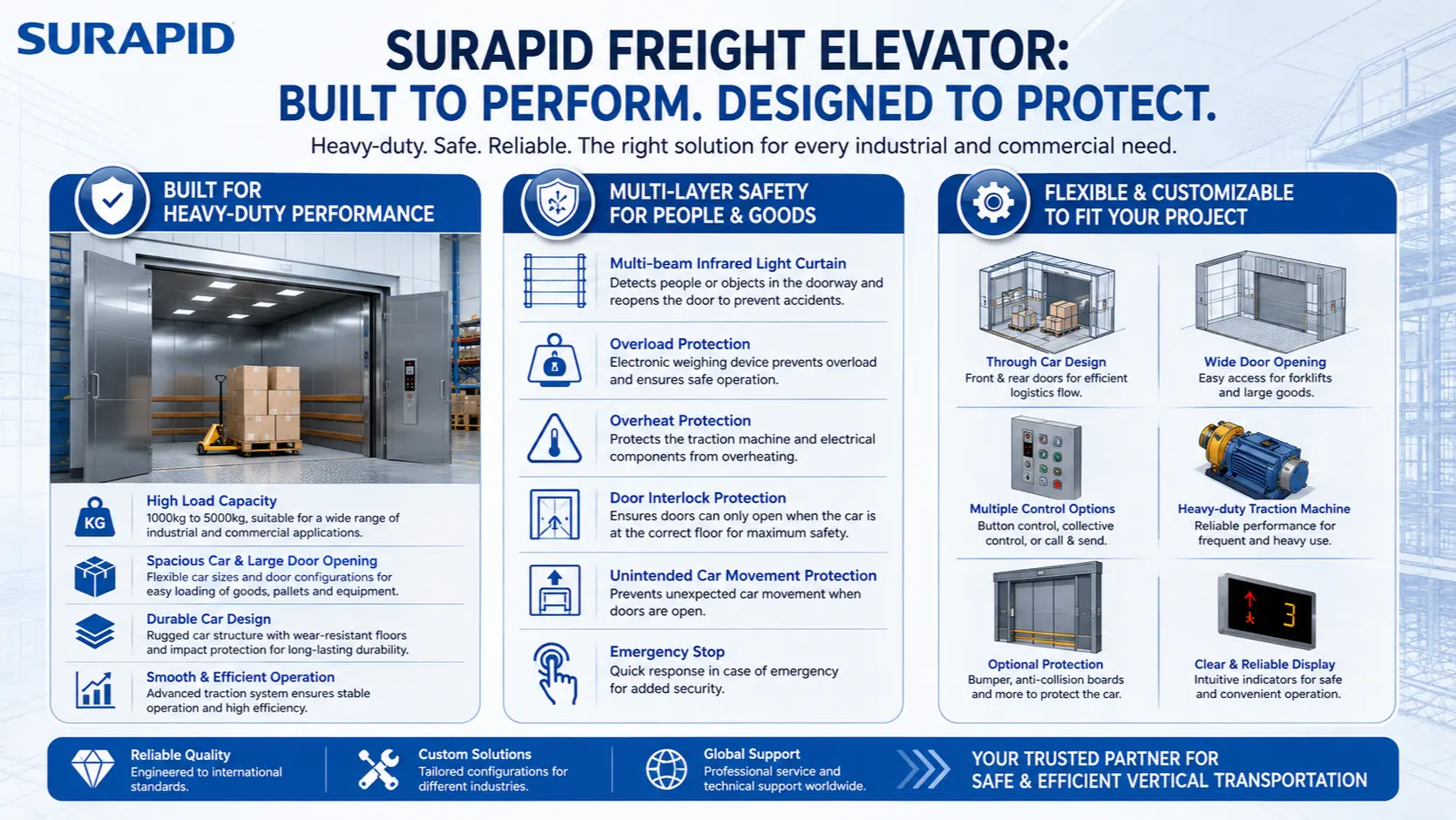
One of the most common mistakes in freight elevator selection is looking only at rated load.
A 2,000 kg elevator does not automatically provide enough floor area for a 2,000 kg pallet or industrial trolley.
The car's net width and depth determine how much usable space is available inside the elevator.
For example, SURAPID's Jieda cargo elevator range includes a 2,000 kg configuration with a net car size of approximately 1,732 × 2,285 mm. A 3,000 kg configuration can reach approximately 2,032 × 2,670 mm, while a 5,000 kg configuration can reach approximately 2,432 × 3,470 mm.
These examples illustrate an important principle:
Higher capacity often requires a larger car, but the correct cargo elevator dimensions should still be determined by the actual loading requirements.
A larger car is not automatically better. Increasing car size also affects shaft dimensions, structural loads, equipment configuration and construction cost.
A surprisingly large cargo elevator can become difficult to use if the door opening is too narrow.
Consider a project using pallets or forklifts. The cargo may physically fit inside the car, but the loading operation can still fail if the freight elevator door opening does not provide enough clearance.
SURAPID's cargo elevator drawings provide examples ranging from 1,500 × 2,100 mm net door openings on smaller configurations to 2,400 × 2,400 mm on a 5,000 kg configuration.
The important point is that door dimensions should be selected together with the loading equipment.
For a forklift application, check not only the forklift's overall width, but also the required turning and alignment space.
OSHA similarly emphasizes that elevators used with powered industrial trucks must have sufficient capacity, overhead clearance and space for the truck and operator.
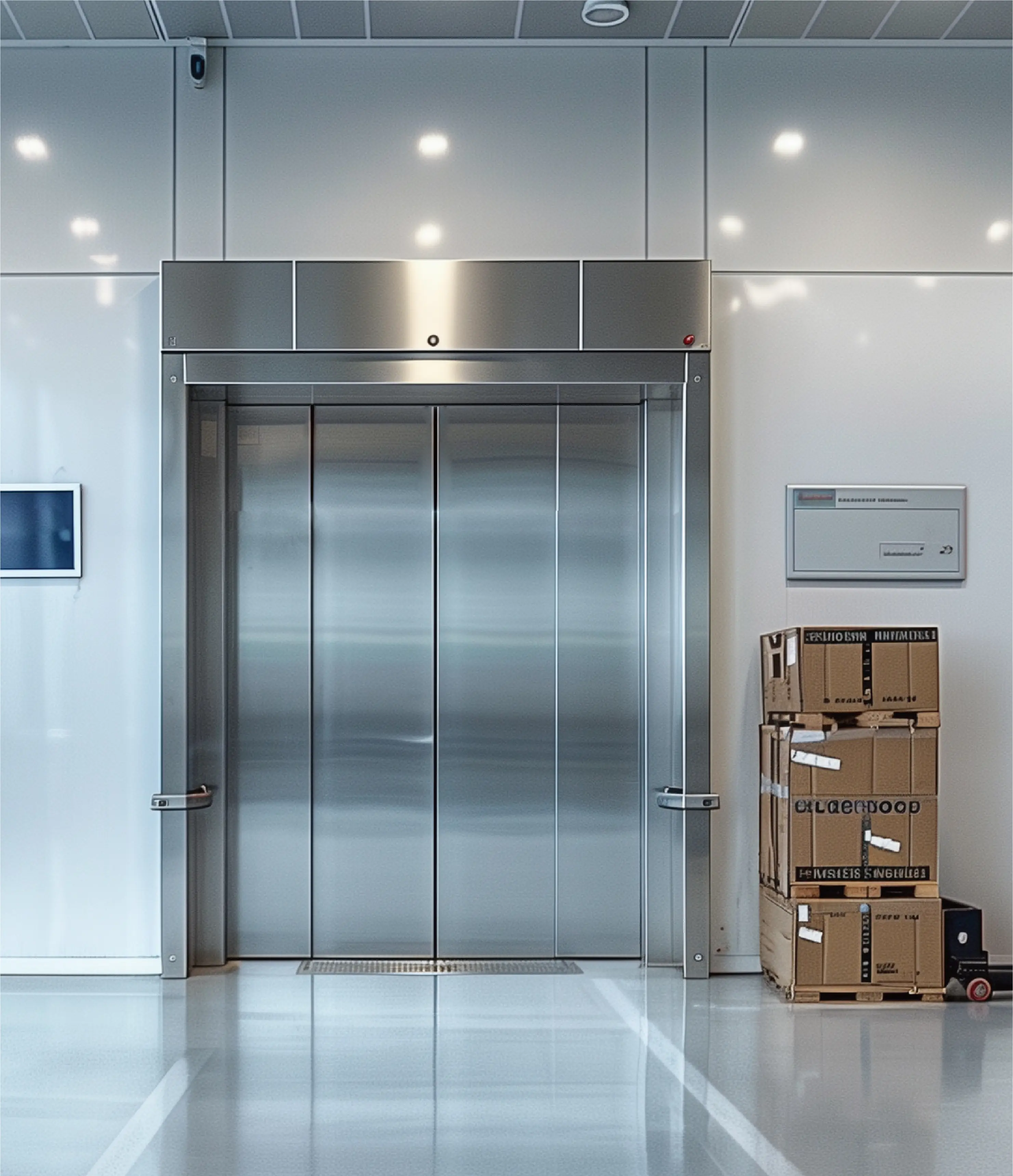
Another common mistake is treating the cargo elevator car size as the same thing as the shaft size.
They are not.
The elevator shaft must accommodate the car, guide rails, counterweight, door equipment, operating clearances and other components.
For example, one SURAPID 2,000 kg cargo elevator configuration has a net car width of approximately 1,732 mm, while the corresponding shaft dimensions are substantially larger. A 5,000 kg configuration can use a car approximately 2,432 × 3,470 mm, while the shaft can reach approximately 4,200 × 4,000 mm depending on the configuration. (For more details, please refer to the SURAPID technical drawings catalogue.)
This is why a cargo elevator should be coordinated with the building structure before construction begins.
The shaft width, shaft depth, pit depth and overhead conditions should all be checked against the manufacturer's final civil drawing.
SURAPID's drawings explicitly state that the listed parameters are for reference and that the final dimensions are subject to the confirmed civil drawing.
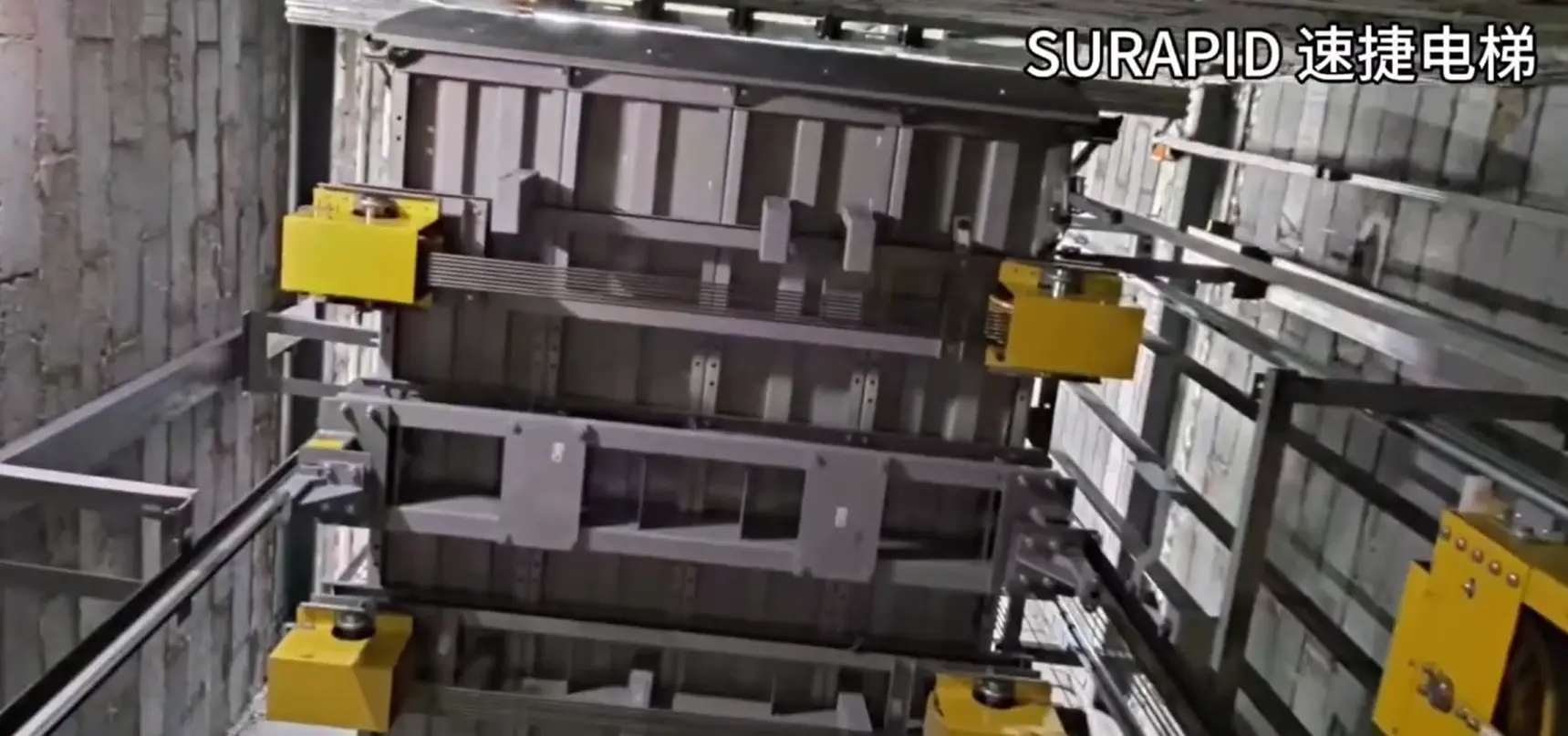
The loading method can be just as important as the cargo itself.
A manually loaded cargo elevator may only require enough space for workers and carts. A project using forklifts requires additional clearance and must consider the combined weight of the forklift and its load.
OSHA specifically requires the elevator to have sufficient rated capacity for the combined weight of the load and truck, while also requiring adequate space and overhead clearance.
This creates several additional design questions:
· Can the forklift enter the car squarely?
· Is the door opening wide enough?
· Is there enough turning space?
· Can the car floor withstand the loading conditions?
· Is the load likely to be off-center?
· What is the maximum combined load?
These questions are particularly important for industrial plants, warehouses and manufacturing facilities.
A cargo elevator designed for industrial use must also consider structural and operating conditions.
SURAPID's civil drawings show different guide rail bracket spacing, pit depths, shaft dimensions, machine loads and support reaction forces for different cargo elevator configurations. For example, the 5,000 kg configurations shown in the drawings use a guide rail bracket spacing of 1,500 mm, while the drawings also specify a minimum pit depth of 1,800 mm for that configuration.
The 3,000 kg configuration shown in the drawings uses a minimum pit depth of approximately 1,650 mm, with different structural parameters from the 2,000 kg models.
These details demonstrate why cargo elevator design should be treated as an engineering system, rather than simply selecting a larger motor or increasing the rated load.
Cargo elevator speed should also be considered in relation to building height and traffic requirements.
SURAPID's Jieda cargo elevator configurations cover speeds from 0.25 m/s to 1.5 m/s across 2,000–5,000 kg capacities.
For a low-rise warehouse with relatively low traffic, a high-speed elevator may provide little practical benefit.
For a multi-story commercial or industrial building with frequent material movement, higher speed can reduce waiting and transportation time.
The correct choice therefore depends on:
travel height + number of stops + traffic frequency + loading cycle + required productivity.
The building itself can influence whether a machine-room or machine-room-less cargo elevator is more appropriate.
A traditional machine-room cargo elevator can provide a familiar arrangement for projects with sufficient space above the shaft.
An MRL configuration can help reduce the dedicated machine-room requirement, but the shaft and overhead conditions still need to accommodate the selected equipment.
SURAPID's civil drawing manual includes both machine-room and machine-room-less cargo elevator configurations, with separate dimensional and structural parameters.
The choice should therefore be made during the architectural and structural planning stage rather than after the shaft has already been fixed.
Before requesting a cargo elevator quotation, prepare the following information:
Project requirement | Why it matters |
Rated load | Determines the basic elevator capacity |
Maximum cargo weight | Prevents under-sizing |
Cargo dimensions | Determines car size |
Pallet/trolley dimensions | Determines usable floor area |
Forklift dimensions | Determines door and car clearance |
Door width and height | Determines loading feasibility |
Car width × depth | Determines usable cargo space |
Shaft width × depth | Determines installation feasibility |
Pit depth | Affects civil construction |
Headroom | Affects elevator configuration |
Travel height | Influences speed and system design |
Number of stops | Influences operation |
Traffic frequency | Helps determine required speed |
Local elevator code | Determines applicable safety requirements |
The manufacturer's final civil drawing should always take precedence over preliminary dimensions. SURAPID's manual makes this point explicitly, noting that the listed parameters are reference values and that final dimensions are subject to the confirmed civil drawings.
The right cargo elevator is not necessarily the one with the highest capacity.
A better approach is to work backward from the actual logistics process.
Start with the cargo. Then determine the required car dimensions, door opening, loading equipment, shaft dimensions, pit and headroom conditions, travel height and operating frequency.
For reference, SURAPID's Jieda cargo elevator range demonstrates how significantly these parameters can change across different capacities—from approximately 1,732 × 2,285 mm car dimensions at 2,000 kg to 2,432 × 3,470 mm at 5,000 kg, with corresponding changes in door and shaft dimensions.
That is the key principle behind proper cargo elevator sizing:
Capacity tells you how much the elevator can carry. Dimensions and configuration determine whether you can actually use it efficiently.